Why Does the Wind Blow? A Kid-Friendly Science Explanation for Curious Families
Why does the wind blow?
It often starts with a simple moment. Your child leans into a gust, watches leaves skitter across the sidewalk, or asks why the trees are dancing. Then comes the question parents hear everywhere: why does the wind blow?
The short answer is that wind is air on the move. The longer, more interesting answer is about warmth, balance, and the way Earth gently tries to even things out.
This explanation is designed for parents to share with children ages 3–12, with language you can adjust depending on your child’s age and curiosity.
The big idea: warm air and cool air don’t stay still
Air is invisible, so kids often think it isn’t really "there." But air is a real thing, and it reacts to heat.
Here’s the core science made friendly:
- Warm air spreads out and rises.
- Cool air squeezes together and sinks.
- When warm air rises, cooler air moves in to take its place.
That moving air is wind.
You can think of wind as Earth’s way of sharing temperature. When one place gets warmer than another, air starts traveling to help balance things out.
The analogy that usually clicks
The Analogy: Imagine a crowded playground.
When one corner suddenly empties out, kids nearby rush in to fill the space. No one planned it. It just happens because space opened up.
Warm air does the same thing. When it heats up, it spreads out and leaves a kind of open space behind. Cooler air rushes in to fill that space, and suddenly, you have wind.
This comparison works especially well for kids ages 5–9, who understand movement and fairness but don’t need technical words yet.
A script you can actually use
"The wind blows because some air gets warm and floats up, and other air moves in to replace it. The air is just traveling, like it’s going on a little trip."
This sentence keeps things accurate without overwhelming younger kids, and it leaves room for follow-up questions.
Why wind can be gentle one day and wild the next
Children often notice that wind doesn’t always feel the same. Sometimes it tickles their face. Sometimes it knocks over trash cans.
Here’s what changes:
- Bigger temperature differences make stronger wind.
- Fast-moving weather systems push air quickly.
- Mountains, buildings, and trees can squeeze wind and make it feel stronger.
You might say:
"When air has to move really fast to fix a big temperature difference, the wind feels stronger to us."
This helps kids understand that strong wind isn’t angry or dangerous by itself—it’s just busy.
A quick activity: seeing wind without seeing wind
The Do: Try this simple experiment.
- Hold a pinwheel, ribbon, or bubble wand outside.
- Stand still and watch what happens.
- Move to a shady spot, then a sunny spot, and compare.
You can narrate:
"The air is moving even though we can’t see it. The pinwheel shows us where the wind is."
This hands-on moment helps children connect the invisible cause to a visible effect.
How understanding changes by age
Ages 3–4: Wind is something you feel. Explanations should stay sensory.
"Wind is air moving past your skin."
Ages 5–7: Kids can understand simple causes.
"The sun warms some air, and cooler air moves in."
Ages 8–10: They’re ready for systems.
"Different places heat up differently, and air moves to balance it out."
Ages 11–12: You can add precision.
"Wind happens because of differences in air pressure caused by temperature."
Each stage builds naturally without contradicting earlier explanations.
The emotional side of wind (especially when it feels scary)
Some children love wind. Others feel uneasy when it howls or rattles windows.
You can support their feelings while explaining the science:
"It sounds loud, but it’s just air moving fast. The house is strong, and we are safe."
Naming both the emotion and the explanation helps kids feel grounded instead of dismissed.
A common misunderstanding to gently correct
Misunderstanding: Wind is made by trees, fans, or clouds.
Gentle correction:
"Fans and trees don’t make wind—they show us wind. The wind was already there."
This keeps curiosity intact while reshaping the idea.
The adult context (for parents who want the fuller picture)
Scientifically, wind is caused by differences in air pressure. Warmer air creates lower pressure because it spreads out. Cooler air creates higher pressure because it is denser. Air naturally moves from high pressure to low pressure.
The sun is the ultimate driver. Because Earth’s surface heats unevenly—oceans, land, cities, and forests all warm at different rates—air is constantly shifting. Add Earth’s rotation and geography, and you get everything from gentle breezes to powerful storms.
You don’t need all of this for kids, but it helps you answer confidently when questions deepen.
Bringing it back to the big question
So, why does the wind blow?
Because the sun warms Earth unevenly, warm air rises, cooler air moves in, and the air starts traveling. Wind is simply air trying to find balance.
When children understand that, the wind stops feeling mysterious or moody and starts feeling like part of a big, beautiful system they’re learning to notice.
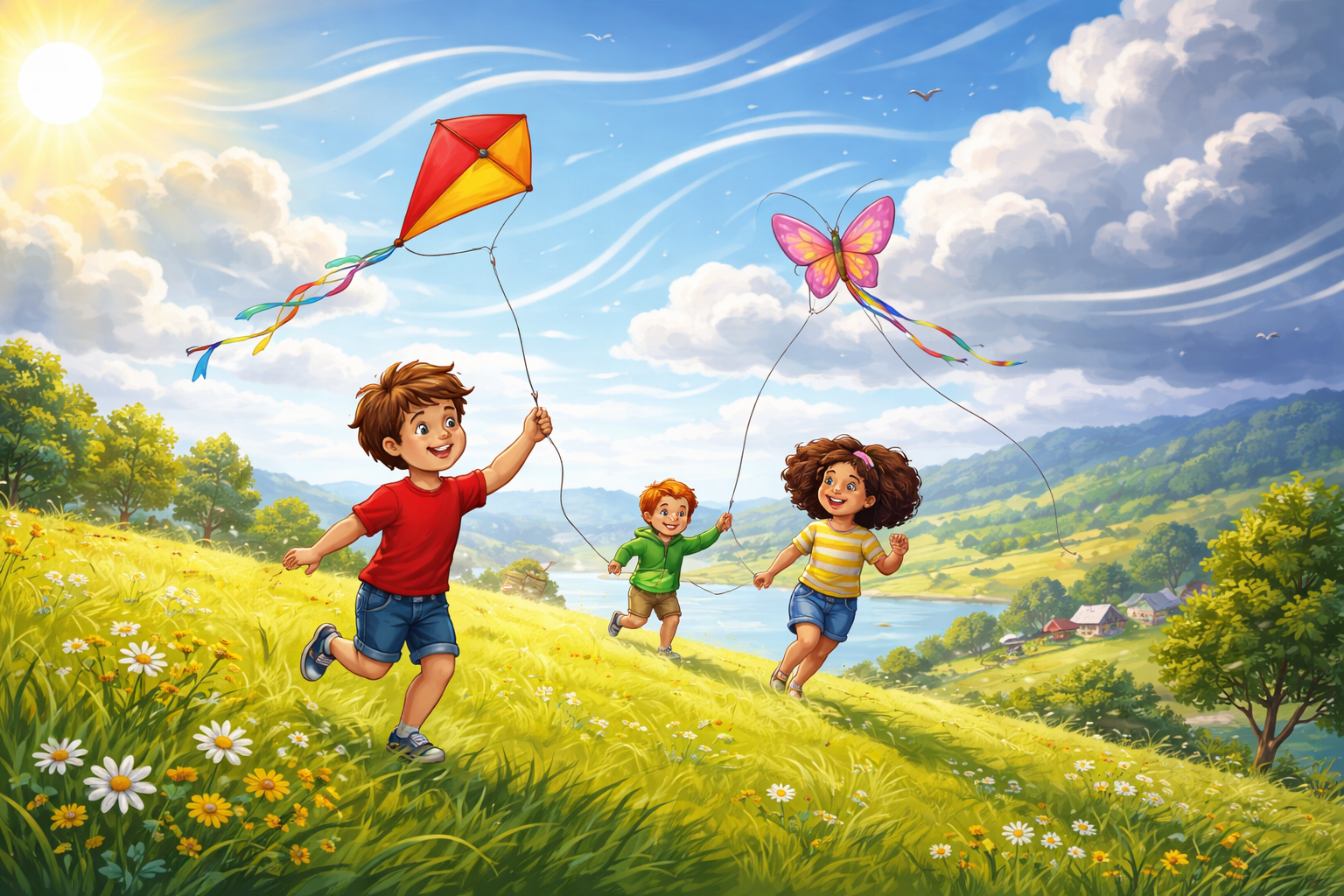
And the next time a breeze tugs at their jacket or lifts a kite into the sky, they’ll know: the air is on the move, and Earth is doing what it does best—keeping things in motion.
Start explaining the world today
Join thousands of parents who use Little Answers to turn 'Why?' into a moment of connection.