How to Explain Why the Moon Looks Like It Follows Us to Kids
Why the Moon Seems to Follow Us
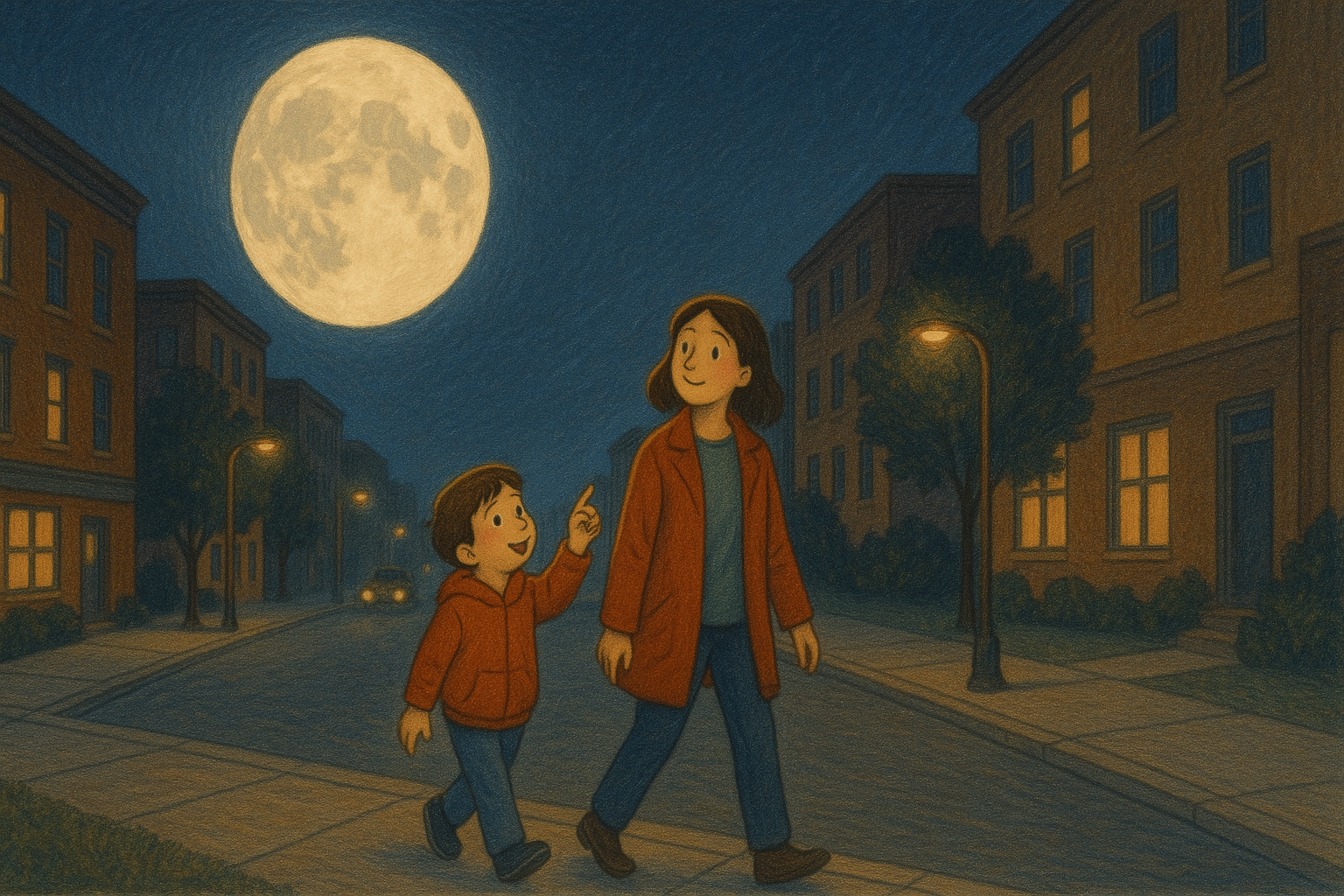
If you’ve ever been on an evening walk or a car ride with a child, you may have heard the very observant question: "Why does the Moon follow us?" This moment is golden—it's curiosity at its best. And even though the science behind it is solid, the feeling of the Moon gently keeping pace with us is wonderfully poetic. Let’s help parents turn this question into a confident, joyful conversation.
The Script (Try Saying This)
"It looks like the Moon is following us because it's really, really far away. When something is far away, it doesn't seem to move as much when we move. So even though we’re walking or riding in the car, the Moon stays in the same place in the sky, and it feels like it's keeping us company."
"Close things—like trees or houses—zip past us. But faraway things—like clouds and the Moon—move slowly or not at all. Our eyes can’t see the Moon’s tiny movements, so it looks like it’s following along."
These simple sentences give kids the key idea: distance changes how movement looks.
The Analogy: The Giant Balloon in the Sky
Imagine you're holding a balloon in your living room. If you walk across the room, you’ll see the balloon clearly shift position. Now picture a giant balloon floating miles away. If you walk the same few steps, it barely seems to budge.
This is what’s happening with the Moon—but even more dramatic. The Moon is about 238,000 miles away. That’s so far that even when you move a whole mile on Earth, the Moon’s position in the sky hardly seems to change. Because your brain compares it to nearby objects that move quickly out of view, your mind says, "Hey, that thing must be coming with us!"
The Adult Context (The Deeper Science)
Children are noticing a classic parallax effect, even if they don’t know the name. Parallax is the way an object seems to shift position when your point of view changes. Nearby things show lots of parallax; faraway things show very little.
For example:
- A mailbox by the sidewalk zooms past your window as the car moves.
- A mountain in the distance creeps slowly.
- The Moon, unimaginably farther away, appears stationary.
The Moon does move across the sky, but it moves slowly—about its own width every two minutes. That’s far too subtle for a child to compare against their own walking or car-riding speed. As a result, the Moon looks like a loyal friend floating right beside your family.
Another factor: your brain always assumes that objects high in the sky are incredibly far away, and that’s true here. Because your brain doesn't get new clues about the Moon’s distance while you’re moving, it keeps the Moon right where it was: overhead, steady, companion-like.
This is why the effect can feel so magical.
What to Do (Activities to Explore Together)
1. The Thumb Test
This is a classic parallax demonstration.
- Have your child hold their thumb up at arm’s length.
- Ask them to close one eye, then switch.
- The thumb seems to jump back and forth!
- Now ask them to look at the farthest thing they can see—a mountain, a distant building—and do the same eye-switch.
- The distant object barely moves.
Explain: "Your thumb is super close, so it looks like it jumps a lot. The Moon is super far, so it barely moves at all. That’s why it feels like it follows us."
2. The Streetlight Walk
Walk under a row of streetlights.
- The nearest light will zoom past you as you walk.
- The farthest one down the road seems to move very little.
Ask your child: "Which light is the Moon more like— the close one or the far one?"
3. Moon Buddies Drawing
Have your child draw themselves walking with the Moon beside them. Then ask: "Where is the Moon really?" Encourage them to draw a second version showing the Moon far away above Earth. Celebrate both pictures—one for imagination, one for science.
For Older Kids (If They Want More Detail)
You can introduce the idea that the Moon’s apparent stillness is related to relative motion.
Try this explanation:
"If you and a friend are running side by side, you look like you’re not moving compared to each other—even though you are. The Moon isn’t really ‘running with us,’ but because it’s so far away, it seems like it’s staying in our same place. Our movement just doesn’t change our view of it very much."
You can also introduce the concept of angular size—the angle an object takes up in the sky. The Moon’s angular size is about half a degree. When you shift your position on Earth by a few meters or even a kilometer, that angle hardly changes. Kids who like numbers or geometry often enjoy this tiny detail.
Common Myths (And Friendly Clarifications)
Myth: The Moon actually moves along with the car.
- The Moon is moving around Earth, but not in sync with your car. The following feeling is an illusion created by distance.
Myth: The Moon is watching or chasing us.
- While poetic, the Moon isn’t tracking your movement. It’s simply big, bright, and easy to see from anywhere on Earth.
Myth: Clouds move but the Moon doesn’t.
- Clouds are close—just a few miles up—so they shift quickly against the background sky. The Moon’s distance makes its motion far slower to our eyes.
A Warm Way to Frame It
Kids often find comfort in the idea that the Moon is "keeping them company." It’s perfectly okay to honor that feeling.
You can say:
"It feels like the Moon is following us because our eyes see it almost the same no matter where we go. Isn’t it lovely that something so far away can feel so close?"
This is both true and emotionally resonant—science plus wonder.
Fun Facts to Sprinkle In
- The Moon is about a quarter the size of Earth, but it looks big because it’s our closest cosmic neighbor.
- If you drove a car straight up (ignoring the whole gravity thing!), it would take about four months of nonstop driving to reach the Moon.
- The same optical effect is why stars don’t zip across the sky when you move—they’re even farther away!
Bringing It All Home
Kids are natural observers. When they notice the Moon following them, they’re discovering perspective, distance, and motion—big ideas in physics disguised as everyday magic.
When you answer with warmth and clarity, you offer them both truth and wonder: the world is full of patterns they can understand and mysteries they can keep exploring.
The Moon isn’t actually following your family. But the curiosity your child shows? That’s absolutely worth following.
Start explaining the world today
Join thousands of parents who use Little Answers to turn 'Why?' into a moment of connection.