Why Leaves Change Color: A Kid-Friendly Science Guide for Parents
Why Leaves Change Color: A Kid-Friendly Science Guide for Parents
Understanding why leaves change color in autumn is one of those wonderful moments where everyday nature becomes a built-in science lesson. Kids notice the shift before adults do: the red leaf on the sidewalk, the crunch under their shoes, the tree that suddenly looks like it's wearing a sunset. This post uses the "Why X Happens" format to give you simple, confident language to explain the real science to children ages 3–12.
The Big Idea (For Parents)
Leaves change color because trees are preparing for winter. To survive colder months, trees pause their food-making process, break down their chlorophyll (the green pigment), and reveal the other pigments that were hiding underneath all along. Temperature, sunlight, and tree species each play a role—but the heart of the story is energy conservation.
The Script
Try saying this…
"Leaves are like tiny kitchens that make food for the tree. In the summer, they're busy making lots of food, and that's why they're green. But when fall comes and the days get shorter, the tree takes a break. The green color fades away, and the other colors that were hiding underneath finally get to show off!"
This script works for a wide age range, and you can easily add detail for older kids.
The Analogy: Leaves as Solar Panels with Paint Layers
Imagine a leaf as a solar panel covered in layers of colored paint:
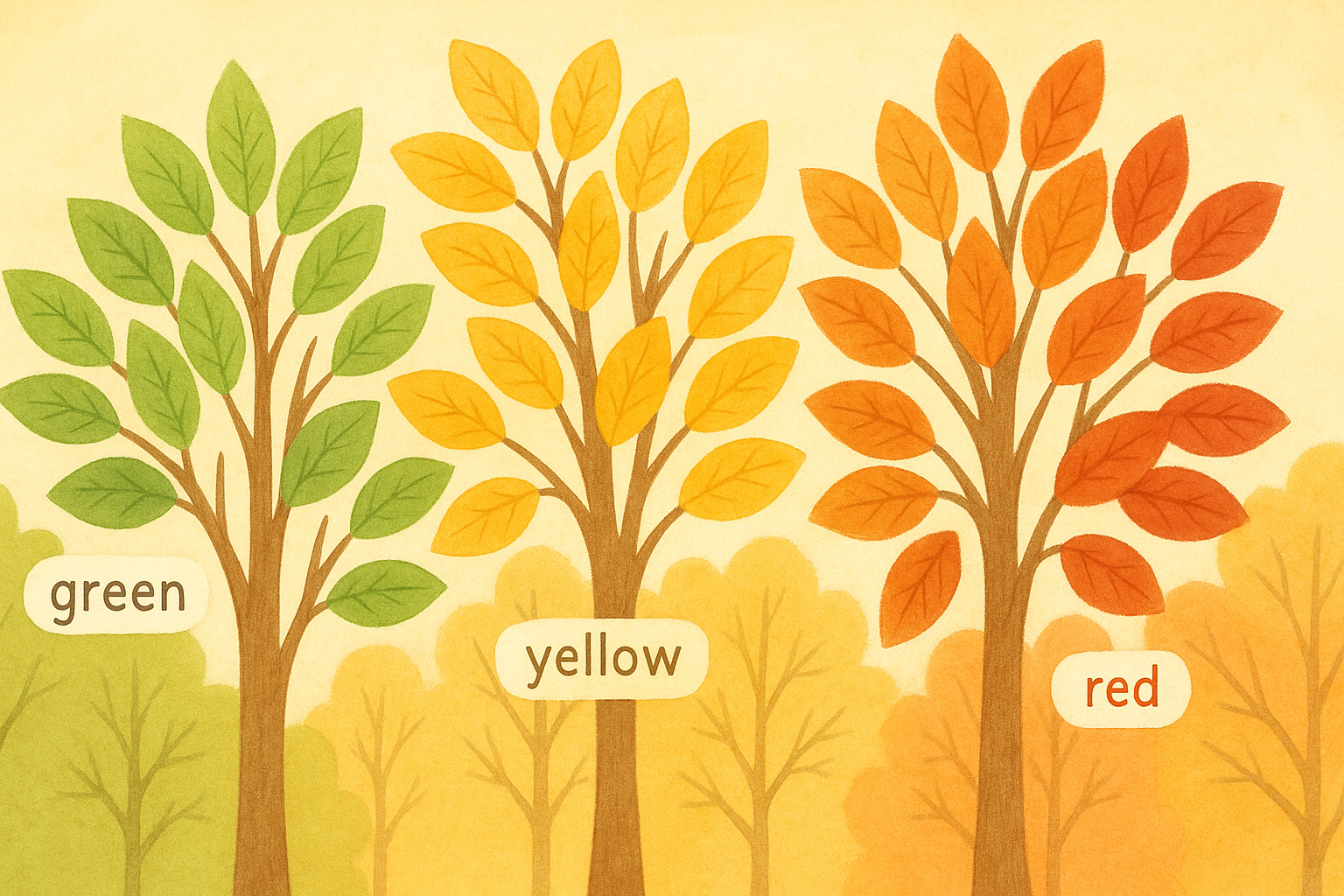
- The green paint (chlorophyll) is on top, working hard to capture sunlight.
- Underneath, there's yellow and orange paint (carotenoids) that you can't see because the green layer is so strong.
- In some trees, there’s also red paint (anthocyanins) that gets painted on only in the fall as a protective coat.
When autumn arrives, it's like the top layer of green paint gets gently washed away, and the hidden colors shine through.
Kids love this comparison because it gives them a concrete visual: layers, colors, and something disappearing to reveal what’s underneath.
The Kid-Friendly Science
Below is language you can use with children at different developmental levels, while keeping it scientifically sound.
For Younger Kids (Ages 3–6)
- Leaves are green in summer because they're busy working for the tree.
- When fall comes, the green color takes a rest.
- The bright colors were always there—they were just hiding!
For School-Age Kids (Ages 7–9)
- Trees use sunlight to make food in a process called photosynthesis.
- Chlorophyll, which helps with photosynthesis, gives leaves their green color.
- As days shorten, the tree slows down photosynthesis and breaks apart the chlorophyll.
- This lets the carotenoids (yellows and oranges) show.
- Some trees make anthocyanins (reds and purples) in fall to help protect the leaf.
For Older Kids (Ages 10–12)
Here you can introduce slightly more detail:
- Chlorophyll is expensive for the tree to maintain, so as daylight decreases, the tree recycles the nutrients inside leaves.
- Carotenoids remain stable, which is why yellow leaves are reliable each year.
- Anthocyanins appear only when certain conditions align: lots of sunlight, cool nights, and good leaf sugar levels.
- Different species = different color patterns: maples turn red, birches turn yellow, oaks turn brown.
Common Misunderstandings (And How to Gently Correct Them)
Even confident kids can mix up cause and effect. Here’s what you might hear and how to reframe it.
**"Leaves get colored by the cold weather."**Not exactly! The cold can help create bright red colors, but the real reason leaves change color is the breakdown of chlorophyll.
**"Trees make colors in summer but save them for fall."**Actually, the yellow and orange pigments are already there; they’re just hiding under the green.
**"If fall didn’t happen, leaves would never change color."**Leaves change because of daylight, not the calendar. The shortening days send the signal.
The Adult Context (Simple, Accurate Science)
- Trees need sunlight to make glucose (sugar), which is their food. They do this through photosynthesis, powered by chlorophyll.
- Chlorophyll breaks down easily, especially when there's less sunlight.
- When chlorophyll levels drop, carotenoids (yellows and oranges) become visible. These pigments help protect the leaf from excess light.
- Anthocyanins (reds and purples) are produced in the fall when sugars get trapped in the leaf. They act like sunscreen, protecting the leaf while the tree reclaims nutrients.
- Eventually, the tree forms a protective seal at the base of each leaf stem, causing the leaf to drop.
Parents don't need to lecture all this — but having it in your back pocket lets you confidently answer the next round of "But why?" questions.
The Do: A Simple Family Experiment
Here’s a hands-on way to explore leaf color with kids.
Leaf Pigment Reveal Experiment
You’ll need:
- Fresh green leaves (not dried)
- Rubbing alcohol
- A clear glass
- A coffee filter
- A small bowl and warm water
Steps:
- Tear the leaves into tiny pieces and put them in the glass.
- Pour in just enough rubbing alcohol to cover them.
- Place the glass in a warm-water bath (don’t let water get inside the glass).
- After 30–45 minutes, you’ll see the alcohol turn green as chlorophyll dissolves.
- Place a strip of coffee filter into the liquid so the bottom touches the alcohol.
- Over the next hour, bands of different pigments will climb the filter.
This is chromatography—and it reveals the hidden yellows and oranges, exactly like fall does.
Parent tip: Emphasize discovery instead of correctness. Kids love seeing that colors they couldn’t see before now show up on the strip.
Emotional Support Angle: Seasonal Transitions
For some kids, the shifting colors and dropping leaves can feel unsettling. It signals change.
You might say:
"Trees change their leaves just like we change our clothes for colder weather. It helps them stay healthy."
Grounding the change in a practical, predictable rhythm helps sensitive kids feel secure.
Parent Takeaways
- Leaves change color primarily due to chlorophyll breakdown as daylight shortens.
- Yellow and orange pigments were always present; red pigments develop only in fall.
- You don’t need to be a botanist—kids respond best to simple, warm explanations.
- Curiosity thrives on wonder. The science helps, but the magic matters too.
Helping your child understand why leaves change color connects them not just to science, but to the rhythms of nature all around them. Fall becomes more than a season—it becomes a story they can watch unfolding in real time, leaf by leaf.
Start explaining the world today
Join thousands of parents who use Little Answers to turn 'Why?' into a moment of connection.